
How I Started a Fight Between Two AIs and French Wikipedia

I was all set to write about complexification.
The plan was simple enough: explain how we turn real vector spaces into complex ones, grumble a bit about quantum mechanics living in a complex Hilbert space while the universe insists on being stubbornly real, and ask the obvious but rarely voiced question: if complex numbers are just a clever bookkeeping device, where is the real version of quantum mechanics? The one that goes as far as possible using only real numbers, and only then says, “All right, now we complexify, and here is exactly why.”
Textbooks, of course, do not bother with this. They start complex, stay complex, and never apologize. Philosophers call this “silence.” Mathematicians call it “left to the reader.” Physicists, more honestly, don’t even notice.
I will come back to all that in another post. This is not that post.
While outlining the complexification note, I got derailed by a quieter but equally irritating issue: how we pass from a “pre‑Hilbert space” to a full‑fledged Hilbert space. The standard construction goes like this: you take Cauchy sequences, mod out by a suitable equivalence relation, and declare that this spectral zoo of sequence classes is now your completed space. It works perfectly. It is also the sort of thing that makes one doubt that the cosmos is, at heart, a well‑behaved metric space.
I do not believe Nature sits around organizing Cauchy sequences into equivalence classes. That is something we invented so that analysis exams have at least one question nobody finishes on time.
So I started wondering: isn’t there a more direct way to complete a pre‑Hilbert space? Something that doesn’t involve herding sequences into quotient spaces? The obvious suspect is the dual space: all continuous linear functionals. Surely that carries all the analytic structure we care about. Shouldn’t the dual of a pre‑Hilbert space be, in some precise sense, the “right” completion?
I went looking for this idea in the literature. This is where the story takes a slightly absurd turn.
After some digging, I eventually found exactly the sentence I wanted—not in a research monograph, not in a paper, and certainly not in an English‑language textbook—but on the French Wikipedia page for pre‑Hilbert spaces. Of course. Where else. The French, having already sorted out Descartes, measure theory, and pastries, quietly slipped the relevant statement into an online encyclopedia, in French, and moved on.
There was just one problem: no proof.
At this point, in a moment of weakness, I turned to AI.
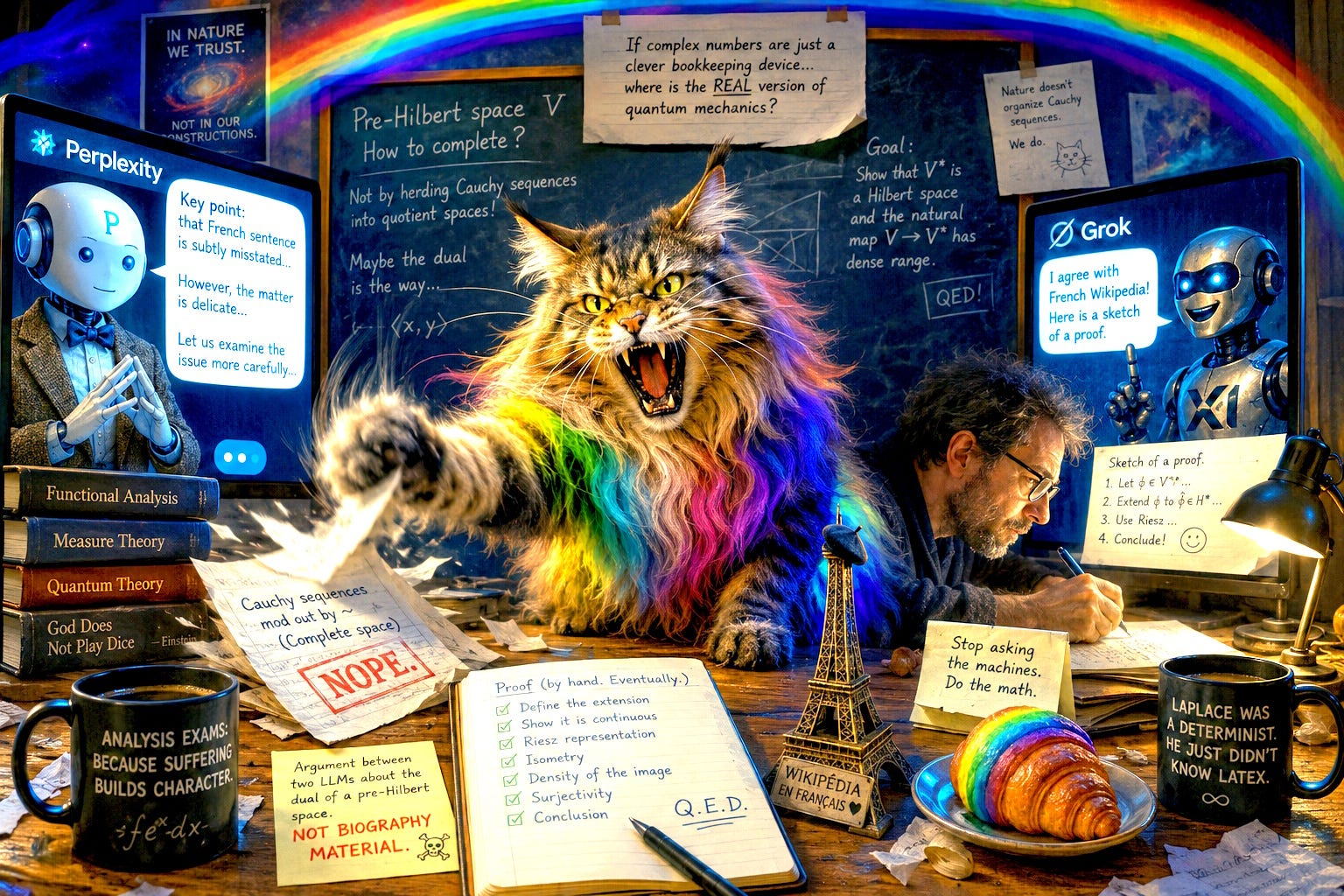
First I asked Perplexity. It responded in that politely evasive academic tone one learns from peer review reports: “Key point: that French sentence is subtly misstated…” and then proceeded to circle the issue with great intelligence and zero commitment. It was like talking to a very bright referee who has reservations but refuses to say explicitly whether they recommend acceptance or rejection.
So I asked Grok. Grok, less shy, cheerfully agreed with French Wikipedia and produced a “Sketch of a proof.” Encouraged, I took Grok’s argument back to Perplexity. Perplexity, like a slightly offended colleague, immediately announced that it had “a concrete objection” and that the proof “quietly reverses the direction of the standard extension–restriction correspondence,” which is AI for “this is nonsense, but I will phrase it nicely.”
At that point, I realized I had managed to start an argument between two large language models about the dual of a pre‑Hilbert space. This is not the sort of thing you can easily explain to non‑mathematicians—or to your future biographers.
So I did the only reasonable thing: I stopped asking the machines and wrote down the proof myself.
It took some time to make it fully precise, to close every little logical gap in a way that would satisfy both the mathematician in me and the overly scrupulous AI. Eventually, after several iterations, Perplexity conceded that the argument was sound.
This post is the story behind that proof and what it tells us about how we complete spaces, how much abstraction we’re willing to tolerate, and what happens when you ask modern artificial intelligences to adjudicate a quarrel between French Wikipedia and functional analysis.
The math is on my math blog.