
It's all about permutations

Permutations appear whenever “things are the same, but in a different order.” That simple idea hides a powerful engine that underlies physics, geometry, information, and even the notion of identity itself.
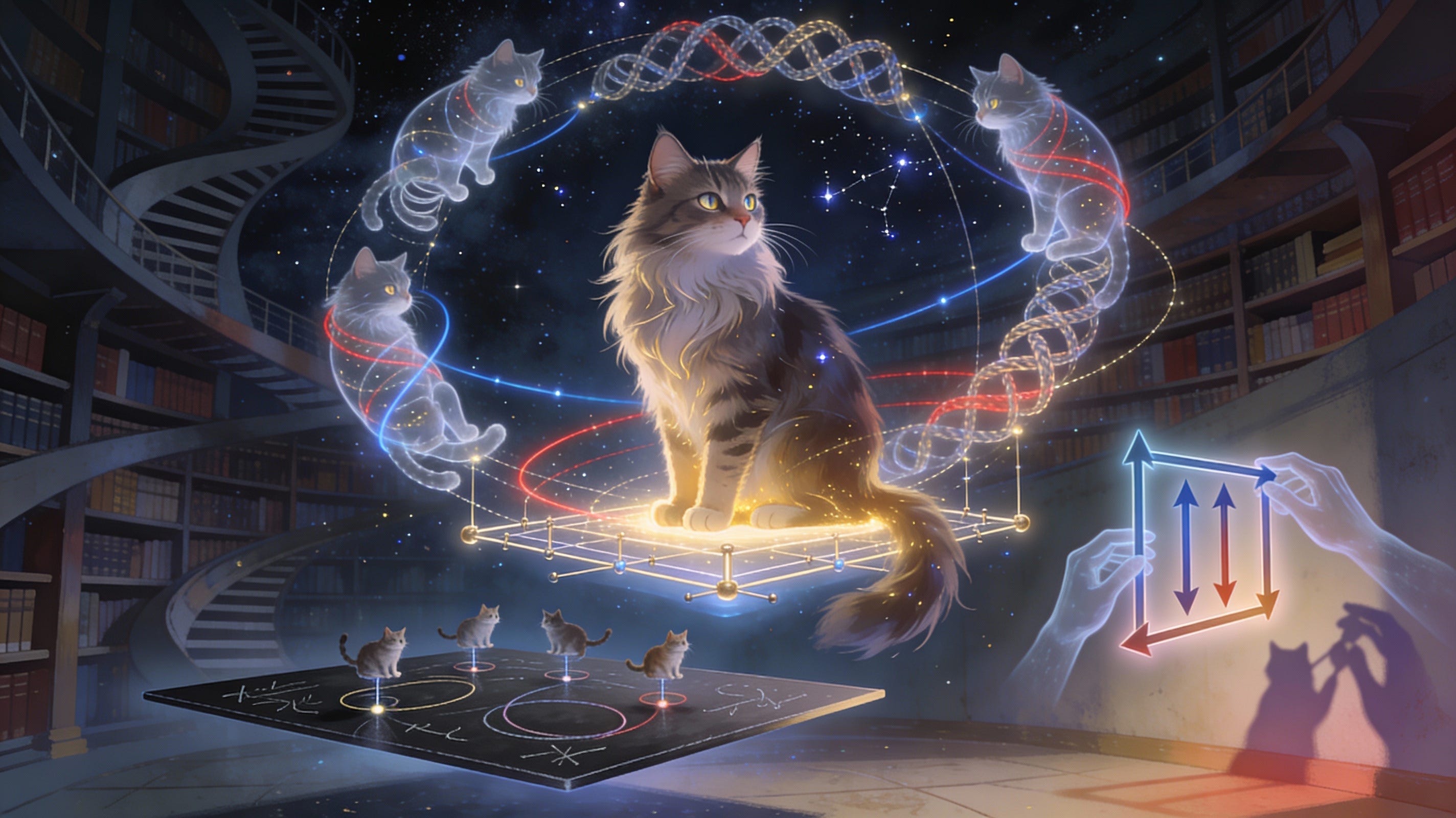
In quantum mechanics, identical particles do not carry little name tags. Two electrons swapped in space give a state that is “the same up to a phase.” The swap is a permutation, and the phase is a one-dimensional representation of the permutation group on two letters.
For bosons, permutations act trivially: exchange two bosons and the wavefunction is unchanged.
For fermions, odd permutations contribute a minus sign, and the Pauli exclusion principle is encoded in this antisymmetry.
More exotic anyons in two dimensions correspond to richer representations of braid groups, which generalize permutations by letting trajectories wind around each other.
Thus whole classes of matter are distinguished by how their quantum states transform under permutations of identical particles. The statistics of the universe are, at base, choices about how permutation symmetry is represented.
In topology, a covering space has fibers over each point; going around a loop downstairs lifts to a permutation of the fiber upstairs. The resulting homomorphism from the fundamental group to a permutation group is the monodromy.
in differential geometry, the orientation of a frame is encoded in whether the change of basis is an even or odd permutation of a fixed oriented basis, wrapped in a continuous transformation.
Permutations are not just a toy in elementary group theory; they are the algebraic shadow of a deeper idea: that the universe is less about what things and relations are, and more about how indistinguishable pieces can be rearranged to create complexity.
After that math follows - on my math blog.