
Quantum Farce: Decoherence's Comical Collapse
A satirical skewering of quantum theory's "experts," from brain-forked physicists to authoritarian echo chambers, revealing how "decoherence" hides the theory's subjective sleight-of-hand.

"Quantum physics' dirty secret? 'Decoherence' isn't solving the classical riddle—it's a mind-game for forked-brain theorists dodging reality's contradictions. From Joos' head-scratching jokes to RWA-scale scientists, this 'magic' is just cognitive dissonance in a lab coat. Dive into the absurdity!

Quantum Magic - Incoherent Decoherence
In my speculations about future physics I will be talking a lot about quantum theory; therefore it would only be fair for me to introduce the subject properly right now, so that my position about the whole subject is clear.
Though there are infinitely many ways in which theory can be introduced, I will choose a way that, I think, is somewhat unusual. I will start with making fun of a representative collection of papers published in a book “Decoherence and the Appearance of Classical World in Quantum Theory”. (“Decoherence and the Appearance of Classical World in Quantum Theory”, K. Giulini, E. Joos, C. Kiefer, J. Kupsch, I.O. Stamatescu, H.D. Zeh, Springer, 1996)

Although the book was published in 1996, not much has changed since then, especially when it comes to the confusion that accompanies the subject.
Erich Joos: Surely You are Joking?
The book is really funny (though being funny was probably not intended by the authors) from the very beginning. Right at the start of the introduction, written by Erich Joos, a theoretical physicist (PhD from the University of Heidelberg in 1983), one of the world champions of the “decoherence program, and the owner of the Decoherence Website “decoherence.de”, we see what this expert has to say about the most wonderful theory of all physics – the quantum theory:
Today there seem to be no phenomena which contradict quantum theory – perhaps with the sole exception that there are definite (“classical”) phenomena at all!
Was this intended to be a joke? What kind of a joke? A cruel one? A childish one? Or a silly one? Or, perhaps, all three together? On the other hand, perhaps it is not a joke at all. Perhaps that is exactly what was in the author’s mind, and what is in the minds of the majority of physicists. I keep my mind open in this respect, but let us analyze the statement above starting with the word “phenomena”, or, more exactly “definite phenomena”. What are these? According to the New Oxford American Dictionary
A phenomenon (from Greek φαινόμενoν), plural phenomena, is any observable occurrence.
English Wikipedia adds to the above:
In scientific usage, a phenomenon is any event that is observable, however common it might be, even if it requires the use of instrumentation to observe, record, or compile data concerning it.
So, anything that occurs, anything that happens, any event, or collection of events, that is just observable, not even necessarily observed, is a phenomenon. And, once it has happened, it is certainly definite! Therefore, according to Erich Joos, literally everything in the Universe contradicts quantum theory, and yet he says that “Today there seem to be no phenomena which contradict quantum theory”!
How can a mind tolerate such a contradiction? Are we dealing here with one of those (medically highly interesting) cases where the right brain is not communicating with left brain? Or, perhaps, this kind of incoherent reasoning is caused by “environmentally induced decoherence”? Or, maybe, we are dealing with a “cognitive dissonance” case?
Intermezzo
Speaking of dissonance in action... For some reason three of my own papers (two with Ph. Blanchard) are quoted in this funny book. Pretty sure I don’t suffer that kind of cognitive dissonance:

What is a "phenomenon"? Here is an example:
Here is another example:
“When you are grateful, fear disappears and abundance appears" ~ Tony Robbins
Of course negative thoughts create ripples of negative energy. Evil creatures are then crawling out of the cracks in the Reality stuff. We are responsible for our thoughts as they affect the whole universe. This is a thought.
Psychological Interlude - Authority in Science
Mistakes Were Made: Cognitive Dissonance
Carol Tavris, social psychologist, and Elliot Aronson, classified as one of the 100 most eminent psychologists of the 20th Century, wrote in their bestselling book “Mistakes Were Made (but not by me)” (Carol Tavris and Elliot Aronson, “Mistakes Were Made (but not by me)”, HARCOURT, INC, 2007)
Cognitive dissonance is a state of tension that occurs whenever a person holds two cognitions (ideas, attitudes, beliefs, opinions) that are psychologically inconsistent, such as "Smoking is a dumb thing to do because it could kill me" and "I smoke two packs a day." Dissonance produces mental discomfort, ranging from minor pangs to deep anguish; people don't rest easy until they find a way to reduce it.
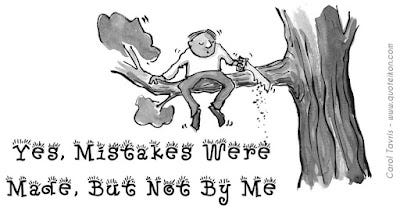
They also wrote:
Naturally, not all scientists are scientific, that is, open-minded and willing to give up their strong convictions or admit that conflicts of interest might taint their research. But even when an individual scientist is not self-correcting, science eventually is.
It seems to me that our psychologists have made two mistakes here (though they can say: perhaps mistake were made, “but not by us”). First, when they wrote that science is “eventually self-correcting”, that was based on their wishful thinking, not on data. Some science is self-correcting, but there is no rational reason for believing that all science is such. Second, when they wrote about cognitive dissonance that “people don't rest easy until they find a way to reduce it”; that was also their wishful thinking plus lack of knowledge. They did not know about “Authoritarian Personalities”. Or they knew, but they suffered from cognitive dissonance and couldn’t deal with the idea that billions of people can hold contradictory ideas in their minds and feel no discomfort at all.
Right Wing Authoritarianism
Let me quote from the Cambridge Dictionary of Psychology : “Authoritarian personality”, and “Authoritarian followers”. According to the dictionary:
Authoritarian followers have the psychological characteristic known as right-wing authoritarianism. This personality trait consists of authoritarian submission, a high degree of submission to the established authorities in one’s society; authoritarian aggression, aggression directed against various persons in the name of those authorities; and conventionalism, a strong adherence to the social conventions endorsed by those authorities. (David Matsumoto, “Cambridge Dictionary of Psychology”, Cambridge University Press, 2009)
Right-wing authoritarianism (“right” comes from “lawful” not a political position) is measured on so called RWA scale. The Dictionary tells us that:
…. persons who get high RWA scale scores quite readily submit to the established authorities in their lives and trust them far more than most people do. They supported Richard Nixon to the bitter end during the Watergate crisis. High RWAs also believed George W. Bush when he said Iraq had weapons of mass destruction, and they supported the war in that country long after others had signed off. High RWAs also are relatively willing to let authorities run roughshod over civil liberties and constitutional guarantees of personal freedom. They seem to think that authorities are above the law. (Italics, mine.)
The Cognition of Authoritarian Scientists

It seems that quite a number of scientists would score rather high on the RWA scale. Bob Altemeyer, one of the champions in the psychology of authoritarians, noticed that authoritarians are characterized by a certain specific cognitive behavior:
Compared with others, authoritarians have not spent much time examining evidence, thinking critically, reaching independent conclusions and seeing whether their conclusions mesh with the other things they believe. (...) They carry a list of ‘false teachings’ and rejected ideologies in their heads. But they usually learned which ideas are bad in the same way they learned which are good – from the authorities in their lives. Highs are not prepared to think critically. (Bob Altemeyer, “The Authoritarian Specter”, Harvard University Press, 1996)
The Neural Basis of Motivated Reasoning
Let us take a look at the neural mechanisms of the Authoritarian Personality (keeping in mind that this book was written back in 2007):
A recent imaging study by psychologist Drew Westen and his colleagues at Emory University provides firm support for the existence of emotional reasoning. Just prior to the 2004 Bush-Kerry presidential elections, two groups of subjects were recruited - fifteen ardent Democrats and fifteen ardent Republicans. Each was presented with conflicting and seemingly damaging statements about their candidate, as well as about more neutral targets such as actor Tom Hanks (who, it appears, is a likable guy for people of all political persuasions). Unsurprisingly, when the participants were asked to draw a logical conclusion about a candidate from the other - 'wrong' - political party, the participants found a way to arrive at a conclusion that made the candidate look bad, even though logic should have mitigated the particular circumstances and allowed them to reach a different conclusion. Here's where it gets interesting.
When this 'emote control' began to occur, parts of the brain normally involved in reasoning were not activated. Instead, a constellation of activations occurred in the same areas of the brain where punishment, pain, and negative emotions are experienced (that is, in the left insula, lateral frontal cortex, and ventromedial prefrontal cortex). Once a way was found to ignore information that could not be rationally discounted, the neural punishment areas turned off, and the participant received a blast of activation in the circuits involving rewards - akin to the high an addict receives when getting his fix.
In essence, the participants were not about to let facts get in the way of their hot-button decision making and quick buzz of reward. 'None of the circuits involved in conscious reasoning were particularly engaged,' says Westen. 'Essentially, it appears as if partisans twirl the cognitive kaleidoscope until they get the conclusions they want, and then they get massively reinforced for it, with the elimination of negative emotional states and activation of positive ones'...
Ultimately, Westen and his colleagues believe that 'emotionally biased reasoning leads to the "stamping in" or reinforcement of a defensive belief, associating the participant's "revisionist" account of the data with positive emotion or relief and elimination of distress. The result is that partisan beliefs are calcified, and the person can learn very little from new data,' Westen says. Westen's remarkable study showed that neural information processing related to what he terms 'motivated reasoning' ... appears to be qualitatively different from reasoning when a person has no strong emotional stake in the conclusions to be reached.
The study is thus the first to describe the neural processes that underlie political judgment and decision making, as well as to describe processes involving emote control, psychological defense, confirmatory bias, and some forms of cognitive dissonance. The significance of these findings ranges beyond the study of politics: 'Everyone from executives and judges to scientists and politicians may reason to emotionally biased judgments when they have a vested interest in how to interpret "the facts." (Cited by Barbara Oakley in “Evil Genes”. Study found here:)
An example of non-authoritarian thinking
Worth repeating
Thinking With a Forked Brain
It seems to me that the thinking of those who write that “Today there seem to be no phenomena which contradict quantum theory – perhaps with the sole exception that there are definite (“classical”) phenomena at all!” is highly compartmentalized. Such a person “thinks with a forked brain, ”exactly as is the case with right-wing authoritarians. The Dictionary of Psychology tells us also that:
"So the picture of authoritarian followers after all these years of research is far from flattering – unless you are a potential dictator."
Indeed, the picture of many of the quantum theorists emerging from their “decoherence” papers is not very flattering. We will see it better after we delve into the subject somewhat deeper.

Further Incoherence
So, let us continue with the preface of the book about Decoherence. First we find a statement that quantum theory, “from a conservative point of view … may well be called inconsistent.” Next comes the admission that standard textbook arguments “are insufficient for several reasons”, and that “conventional treatments” (of the classical limit of quantum theory) “are flawed for a simple reason: they do not represent any realistic situation.”
So, we now know how really bad quantum theory is. It is in terrible shape, everything that is definite and real contradicts it. So, what to do?
The answer, from reading the contributions to this book and to other books and papers, lies in “decoherence”.
But what is this decoherence? Is it something that is objective? Or is it something that occurs only in the minds of some theoretical physicists? In order to answer this question we need to look into these minds.
What is this decoherence that is so fashionable nowadays? According to the French Wikipedia:
The quantum decoherence is a physical phenomenon capable of explaining the transition between them quantum physical rules and classic physical rules as we know them, on a macroscopic level. More particularly, this theory provides an answer, recognized as being the most complete to date, to the paradox of Schrödinger cat and at quantum measurement problem.
The theory of decoherence was introduced by Heinz Dieter Zeh in 1970
So, we learn that “it is a physical phenomenon”. Is it a definite phenomenon or not? If it is definite, then, according to Erich Joos, it would contradict quantum theory. That would be bad. So, I am deducing that it is not a very definite phenomenon. But, it is said that it is a “physical phenomenon”. So, let us check what Mr. Zeh has to say. According to Zeh’s article in the Decoherence book, this decoherence occurs when “the complete information about the passage of the particle is carried away (into the “environment”) in some physical form.”
Information and Environment: What is hidden by Decoherence
So, we have two new terms, one is information, the other one is “environment” – put in quotation marks by Zeh. Why in quotation marks? I checked the number of occurrences of “environment” in the book, and the result is 372. But I could not find even one precise definition. What I have found, however, is that
In quantum cosmology (where no environment exists), decoherence is only meaningful with respect to local observers (subsystems).
What is real? Is Nobel Prize real?
That there may be a problem with “environment of the Universe”, I can imagine, but then he goes to say that decoherence is meaningful only with respect to a local observer. But what exactly is “local observer”? And does that mean that before there were any observers in the universe, this mysterious decoherence did not happen? Is decoherence really something physical or it happens only in the mind of a physicist?
Can Quantum Phenomena Solve the Mystery of Consciousness?
It is, in fact, a physicist who separates, in his mind, the Universe, into two parts; one part he calls “the system”, another part he calls “environment”. Then he starts calculating and comes up with some numbers. Another physicist will make the division in a different way, and will come up with a different set of numbers. So, it seems that all this decoherence business is another way of saying that quantum theory really is not able to get rid of subjectivity, and all this fashionable decoherence program is just a way to hide this fact under a pretentious name.
Is that really the case?
Well, I will show that it is even worse than that. But we need to talk about Schrödinger’s cat first.
What is REAL? Here is an example:
Mark Knopfler & Emmylou Harris - I Dug Up A Diamond
Real Live Roadrunning
My wife likes this... so this is for her. Very REAL lyrics are here.