
When “Random” Radioactivity Misbehaves

There are unexplained phenomena in nature. Let me mention one example that I find especially relevant to my own work: radioactivity. Radioactive decay is usually regarded as a genuinely random quantum process. Yet there are experiments suggesting that this “true” randomness may be influenced by unknown agents.
One such case is a series of experiments carried out by Alexandr G. Parkhomov at the Institute for Time Problems Research, Lomonosov Moscow State University, Moscow. In his 2005 paper, Bursts of Count Rate of Beta‑Radioactive Sources during Long‑Term Measurements, he reports time‑ and orientation‑dependent bursts in the count rate of beta radioactivity. There may be several possible explanations for these bursts and their dependence on time and on the orientation of the detector.
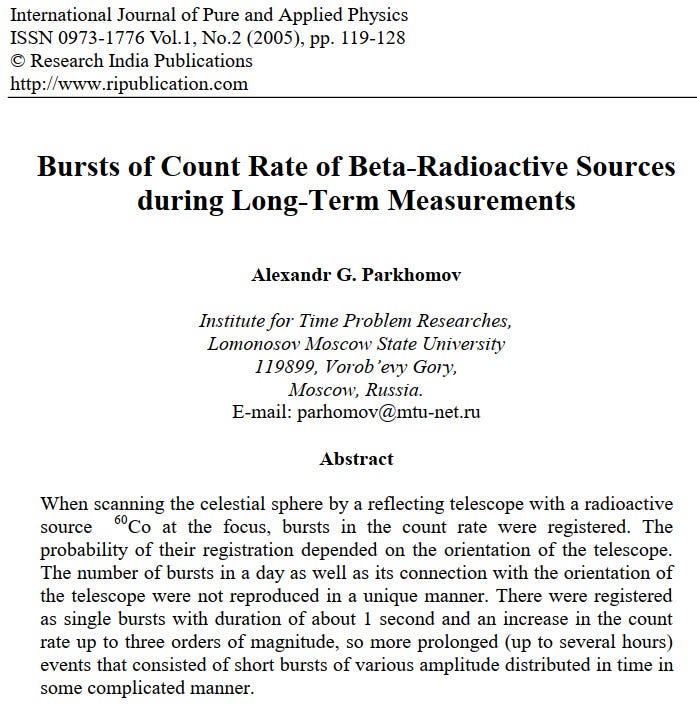
Parkhomov, an experimental physicist, looks for an explanation in exotic properties of antineutrinos. Other physicists—mainly theorists—who accept the reality of these anomalies are willing to entertain broader speculations, including “action at a distance”–type interactions normally avoided in mainstream physics.
I go even further and look for a variable geometry of quantum probabilities, which naturally leads to infinite‑dimensional spaces. The simplest of these, only slightly beyond those already used in quantum theory, are called Krein spaces. Below is the introduction to my new math blog post: Krein spaces – first steps.
It was the summer of 1964 (15 June–15 July). The small village of Katsiveli, in the Yalta region of Crimea, hosted the Second Summer School of Mathematics organized by the Ukrainian Academy of Sciences
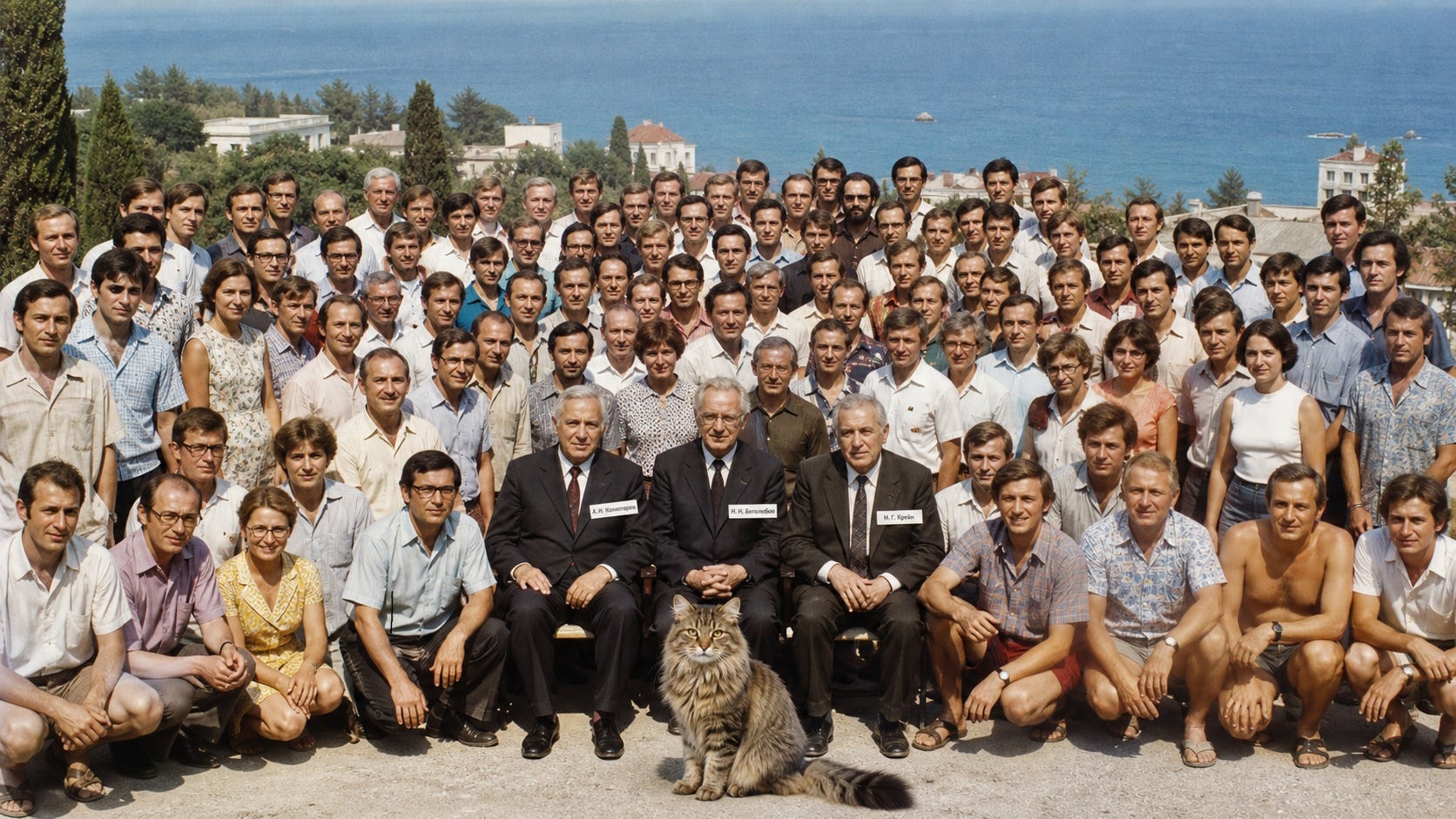
.Second Summer School of Mathematics, Katsiveli, June-July 1964. In the first row (behind the cat), from left to right, A.N. Kolmogorov, N.N. Bogolyubov. M.G. Krein.
One of the lecture series was delivered by M.G. Krein, under the title Introduction to the Geometry of Indefinite J-Spaces and to the Theory of Operators in These Spaces. Here is the first page of the printed lectures:
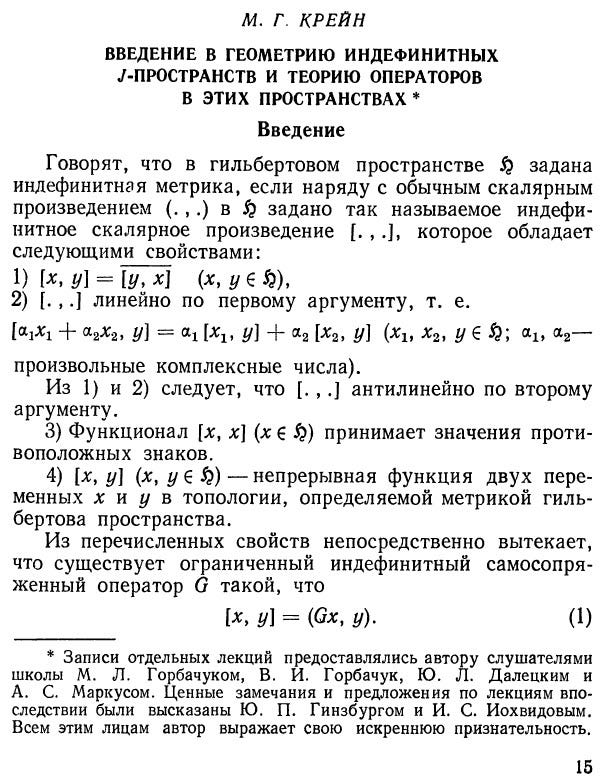
Over 77 pages, Krein develops the theory of what he calls “J-spaces.” Today, these are known as Krein spaces, and it is precisely these objects that will concern us here: a particular class of infinite-dimensional spaces endowed with an indefinite metric. They generalize Hilbert spaces—but in a somewhat dangerous direction. Physicists tend to treat them with caution, and often avoid them altogether. Used incautiously in quantum theory, they may lead to “negative probabilities,” which sounds unsettling enough to conjure up “ghosts.” Physicists, as a rule, prefer to avoid ghosts—or to exorcise them as quickly as possible.
But here we are free to play with mathematics: with algebra and geometry in infinite dimensions, where much can be learned. I do, of course, have applications in mind. I even entertain the idea of applying the mathematics of Krein spaces to consciousness. Physicists—Roger Penrose being a notable exception—tend to shy away from consciousness as well, since no widely accepted way of “measuring” it has yet been found. So let us now turn to Krein spaces, as I see them.
On X: 'A geometry problem posed by legendary mathematician Paul Erdős in 1946 may have just been overturned… by an AI.
The problem sounds simple on the surface:
How many pairs of dots can exist on a flat plane while all being exactly the same distance apart?' https://x.com/CharlesMullins2/status/2058013449213649117
Beautiful Feline!